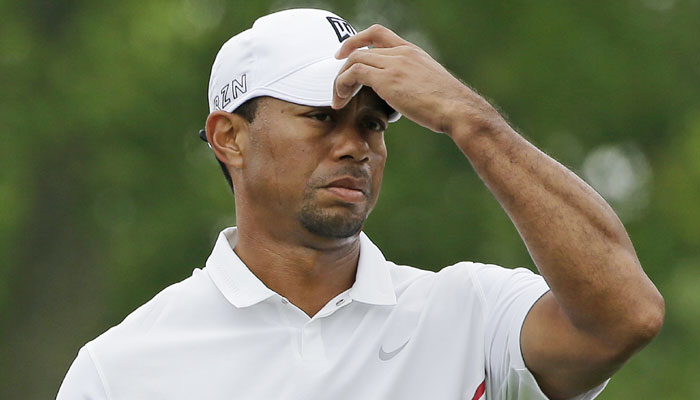
85 shots around Muirfield Village in the Memorial Tournament was a new low for Tiger Woods and demonstrated the struggle that he faces to remain competitive on tour. While the 14-time major champion has made a career out of proving people wrong, he looked seriously confused on the course at the weekend. He went in the water four times, sprayed his drives left and right and chipped abysmally. Earlier in the year, Woods took a break from golf in order to bring his game back to a place that he felt would leave it competitive. The first three days of the Masters in his return were promising but the problems have continued. Comparing his statistics from three years under three different swing coaches (Butch Harmon, Hank Haney and Sean Foley), we can see just where Tiger is floundering and why is no longer the golfer that he used to be.
Driving:
In Tiger’s peak season of 2000, where he won three majors and nine times in total (including one major by a mind-boggling fifteen shots), his driving distance was 298 yards in an era where 300 yard drives were uncommon. Woods’ prestigious length was one of the main reasons for his dominance and it led to a ‘Tiger-proofing’ exercise of lengthening golf courses all across the world, the most notable being Augusta National which Woods won only once after 2002. The improvement of equipment (drivers and golf balls) saw the average drive on tour increase by at least ten yards in the following ten years. For example in the year 2000, Tiger was second in driving accuracy, ten yards ahead of third, whereas in 2015, 298 yard average would be in twenty-fifth place on tour. But perhaps more importantly, Tiger’s driving accuracy was well above average as well, hitting 71% of fairways. He was a machine with the long stick.
By 2006, Tiger’s driving accuracy percentage had dropped to 61% but still more than high enough to remain very competitive off the tee, especially given that he had upped his driving distance to 306 yards in line with progress in equipment. Tiger’s driver became a problem club for him in the late-Haney era/early Foley-era, reaching a low of 48% accuracy in 2011. However a lot of work in the off-season had brought Woods’ driving accuracy back to a respectable 64% in 2012 as he went on to win three times.
In 2015, Tiger’s driving distance is not a problem at 299 yards, he lags behind the really big hitters such as Rory McIlroy, Dustin Johnson and Bubba Watson but that should be the least of his concerns. He hits the ball much further on average than Masters Champion Jordan Spieth for example.
It is his driving accuracy that is a massive problem. It is back to 2011 levels of 48%. Missing more than half the fairways in a round is very destructive. Not only is he missing fairways, he is missing them comprehensively. At an average of almost 15 yards from the edge of the fairway with every wayward drive, he is the worst on tour statistically in this respect.
Ball-striking:
In the year 2000, Tiger hit 75% of greens in regulation, leaving himself a birdie putt or better in three of every four holes. Perhaps more impressive was his 74% greens in regulation percentage in 2006 given that he had missed the fairway 10% more often than 2000. The Haney era may have been the peak of Woods’ iron play, as evidenced by Woods’ dismantling of Royal Liverpool in the Open that year with irons of the tee.
By 2012, his GIR stat had fallen to 67%, more in line with the tour average. In 2015, his GIR is at 56% which is second worst on tour. Interestingly in 2011, the year where he had a similarly poor driving accuracy percentage, he hit 68% of greens in regulation. That would suggest that it is not just being in poor position that is causing Tiger to miss greens. His iron play may not be in as poor of a state as other parts of his game but is not razor sharp either. Yet, his horrific driving is ultimately impacting this facet of his game. It is ultimately easier to hit a green from the middle of the fairway. To put the fall into perspective, if we take it that he is playing the standard four rounds of a tournament, the former world number one is hitting 14 less greens per event than 2006 Tiger.
Short game:
Woods’ short game in 2000 was exceptional and genuinely exciting to watch, you sensed greatness around the greens when he had a wedge in hand. It was much more likely for Woods to chip the ball into the hole than for him to duff a chip. Accordingly, his scrambling stat – that is the ability to save par from missing a green in regulation – was at 67% which would put him second on tour today. By 2006, it had dropped to 63% but that is still a strong percentage.
In 2012, it was 63% again. Post-scandal through various injuries, swing changes and so on, Tiger had retained the ability to get up and down expertly even if he was not quite as dominant as he once was. In 2015, his scrambling is at 44%. It is again worst on tour. Tiger’s early year chipping woes shocked the golfing world from someone so naturally gifted at pitching and chipping the ball. He has hit a number of shots not befitting a professional golfer, skulled chips, duffed chips, hitting a bunker shot into another bunker. At times, it has been hard to watch. Simply put, missing more greens than usual mixed in with an inability to get pars from the places he hits it to is a losing combination.
Putting:
There was no strokes gained through putting stat in the year 2000, the excellent statistic that rates various putting stats and compares them against the field that week. However, we don’t need to know strokes gained through putting to know how well Tiger putted in 2000. 2000 Tiger was obviously fantastic in so many ways but putting was his forte. It was the first thing that his father taught him growing up and he emphasised that in his best-selling book ‘How I Play Golf’. He told the readers that the first thing that an aspiring golfer should practice is putting and with that fundamental in place, everything moves on from there. His putting average was unsurprisingly second best on tour at 1.7.
By 2006, we have access to the strokes gained through putting stat, which has Tiger at +.451 shots on the field. In 2012, it was +.332 shots. In 2015, it is +.200 on the field. This means that putting is not exactly a pressing problem. He is not holing everything like he used to but he is still gaining shots on the green. In fact, he has his putting to thank for making it through to the weekend at Memorial. It seems as though Tiger has at least never lost the midas touch that he gained as a kid on putting surfaces.
Overall:
One final damning statistic of Tiger’s year is that his round average so far has been 73.5. In the year 2000, his scoring average on Tour was an incredible 67.8. It must be internally demoralising to be playing almost six shots per round worse than a level that you once reached. Tiger will remember the days when he was dominating his competitors and dismantling courses. There must be a certain amount of ego involved in trying to keep up with the younger guys off the tee distance-wise. Trying to retain his top dog status is causing him to swing his driver violently in search of yards instead of focusing on accuracy.
If he wants to improve, he simply has to find a way to make the fairway, even if it means hitting lesser club or swinging easier. This, in turn, should see him hit more greens. It is hard to explain the woes with Tiger’s wedge, although he will be encouraged by the fact that he pitched and chipped well at Augusta when it came to major championship time. Mishit chips are a killer for confidence. There is no easy solution to this part of his game if it is a mental blockage. Unfortunately for Woods, these stats reveal just how far he is off the standard and just how far he has to go to reach the standard of yesteryear. Approaching 40 years old with a crocked body, it is a very worrying time for one of the greatest golfers of all-time.
 The Power Drive