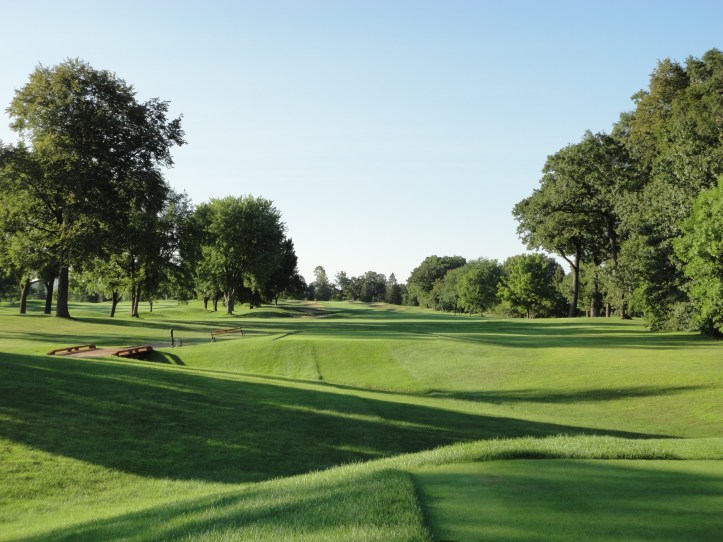
Hazeltine National Golf Club will host this year’s Ryder Cup on what is now a world-renowned and exciting layout. But it was not always this way.
The Robert Trent Jones-designed golf course, located in Chaska, Minnesota was opened in 1962 and eight years later, it hosted its first major championship.
Reviews were less than positive at the 1970 US Open. Dave Hill, who finished second behind Englishman Tony Jacklin, was asked of his opinion on the golf course. When asked what the course lacked, Hill said: “Eighty acres of corn and a few cows. They ruined a good farm when they built this course.”
That cutting critique was similar to the criticism levelled at Chambers Bay at the US Open last year and, like the quirky Washington course, it seemed unlikely for a while that Hazeltine would ever return as a course for major championship golf. The club faced severe financial troubles and it was not until it received a series of renovations that it improved its reputation.
Several dogleg holes were straightened, the par three 16th hole was abandoned and a new par four was laid out along Hazeltine Lake. With a US Women’s Open and a US Senior Open in between, Hazeltine National would be back on the men’s major table at the 1991 US Open, 21 years after its debut, as Payne Stewart beat Scott Simpson in an 18-hole playoff.
The exciting, matchplay-like finish to the 1991 US Open helped put Hazeltine on the map. In the playoff, Simpson led by two strokes heading to the 16th hole. Under pressure, he bogeyed the 16th hole, put his tee shot in the water at the 17th as Stewart turned the screw, birdieing the 16th and seeing out the victory by two shots.
Hazeltine’s next two major appearances also turned out to be one-on-one duels with the same theme – a journeyman pro versus Tiger Woods. Surprisingly, both times the big underdog won the battle.
Signature Hole – 7th Hole
The tee shot on the sixteenth must carry 220 yards over Hazeltine Lake. The green is a raised peninsula which falls off on all sides, including into the hazard in the back and on the right. Off-the-tee, visually there appears to be no margin of error. “If you stand on the tee box and look at the middle of the fairway, all you see is the reeds,” said Tiger Woods. Additionally, the 7th is the only hole you really feel the full effects of the wind. In the 2002 PGA Championship, it averaged almost a half-stroke over par. Johnny Miller once called it the “hardest par 4 I have ever played.”
At the 2002 PGA Championship, Woods dramatically birdied each of the last four holes to post a clubhouse score and put the pressure on tournament leader Beem but the American remained unfazed. He sank a 35-foot birdie putt on the 16th hole to move two shots ahead and went on to lift the Wannamaker Trophy
In 2009, it seemed to be business as usual for Woods, who held a two-shot lead over YE Yang and Padraig Harrington. Tiger held a 100% record at closing majors with a 54-hole lead and if anything, Harrington looked to be the most likely challenger. However, a quintuple-bogey 8 on the par 3 8th hole put the Irishman’s chances to bed.
It left YE Yang to take advantage, as he chipped away at the lead of a struggling Woods, holing from just off the green for eagle on the 14th hole. He eventually sealed the deal with a 210-yard hybrid around a tree to ten feet on the final hole to make birdie and become Asia’s first ever male major winner.
Tiger’s loss at Hazeltine came to be symbolic of his decline, three months later his infamous infidelity scandal came to light. The 14-time major winner has not won a major since that loss. Neither has Padraig Harrington, and both will be vice-captains this time as they advise the American and European Ryder Cuppers of the dangers that can be found at Hazeltine National.
The course has been rerouted this time from the regular Hazeltine set-up as the front nine holes will be current holes 1-4 and 14-18 while the back nine will be current holes 10-13 and 5-9. This means that the signature hole, the 7th (see sidebar), will be robbed of back nine Ryder Cup theatre but it does mean that there will be a par 5 over the last three holes as Hazeltine.
The risk-reward nature of par 5s add to television matchplay and the new 16th hole for the Ryder Cup course is also the only par 5 that is a realistic reach for most of the competitors in two shots. Hazeltine has four par 5s but the other three are over 600 yards (3rd hole – 633 yards, 6th hole 642 yards, 11th hole 606 yards).
This is perhaps the major feature of Hazeltine – it is a long, demanding test at a 7,628-yard par 72. To add to the long par 5s, the 12th hole is a 518-yard par 4 and the 13th hole is a 248-yard par 3. Naturally then, the course should suit long hitters on both teams – Johnson, Watson, McIlroy and Stenson – although Yang was not exceptionally long and Luke Donald once won a NCAA college event here.
In the 2009 PGA Championship final round, no player broke 70 so don’t expect the players to be burning the course up like they were at Valhalla in 2008. It is a long, narrow, hilly course with tight fairways and small greens. Nine of the holes have water hazards, which should provide plenty of drama on Ryder Cup week. Organisers expect to bring 300,000 people through the gates for tournament week, September 27 to October 2. Not bad for a wasted farmland.
 The Power Drive